In the comprehensive approach to the oncological patient, the control of systemic inflammation is one of the fundamental pillars. In recent years, science has turned its attention to phytotherapy, highlighting an ancient extract that is showing promising results in recent clinical trials: Boswellia serrata.
Below, we review the scientific evidence published between 2024 and 2026 to understand how it acts at the molecular level, what benefits it provides, and in which types of tumors it is being investigated more deeply.
What is Boswellia serrata and why is it of interest in integrative oncology?
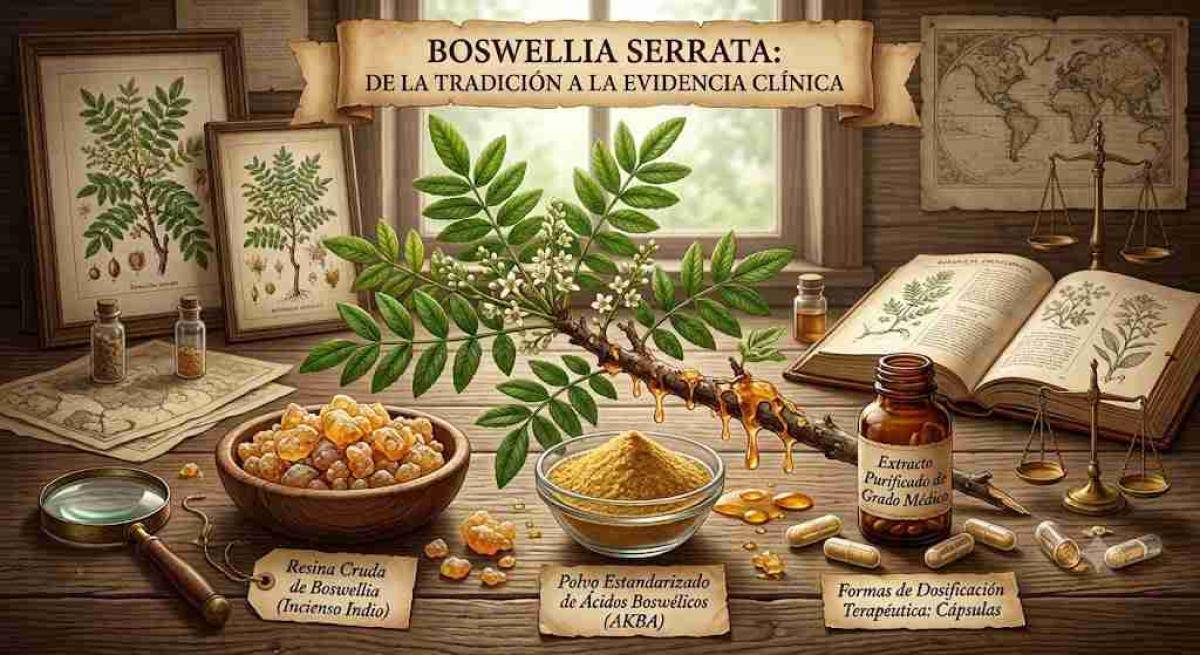
Boswellia serrata, also known as Indian frankincense, is a tree from which a resin rich in bioactive compounds is extracted. In integrative clinical practice, we do not use the raw resin, but rather highly purified and standardized extracts to obtain its most potent active principles: boswellic acids.
Among them all, AKBA (3-O-acetyl-11-keto-beta-boswellic acid) has captured the attention of oncologists and researchers. Far from being a simple natural remedy, AKBA has proven to be a potent modulator of the biological terrain, capable of altering the inflammatory environment that the tumor needs to grow and expand.
Molecular mechanisms of action: How does Boswellia act against cancer?
Preclinical research over the last five years has managed to precisely map exactly what boswellic acids do when they come into contact with tumor cells. Current evidence points to three main pathways of action:
Induction of apoptosis and ferroptosis (Programmed cell death)
Tumor tissue is characterized by its ability to evade natural cell death. Recent studies (2024 and 2025) have shown that Boswellia extract is capable of reactivating apoptosis (cellular "suicide") in malignant cells. Furthermore, prominent research in 2024 evidenced that Boswellia induces ferroptosis, a specific type of cell death dependent on iron and oxidative stress, proving to be especially toxic to tumor cells without damaging the surrounding healthy tissue.
Blockade of signaling pathways and metastasis (PI3K/Akt)
For a cancer to spread (metastasis), it needs to make its way through tissues. A study published in 2025 in the journal Archives of Medical Science demonstrated that AKBA suppresses the motility and invasion of tumor cells by blocking the EGFR/PI3K/Akt signaling axis. Additionally, it drastically reduces the expression of metalloproteinases (MMP-2 and MMP-9), which are the enzymatic "scissors" that tumors use to invade other organs.
Modulation of the tumor microenvironment (5-LOX Inhibition)
Cancer feeds on inflammation. AKBA is one of the most potent natural inhibitors of the 5-lipoxygenase (5-LOX) enzyme. By blocking this enzyme, a key inflammatory cascade is nipped in the bud, making the tumor microenvironment hostile to malignant proliferation, a central effect in our integrative vision of treatment.
Clinical evidence over the last 3 years (2024-2026): What types of cancer have been investigated?
The qualitative leap for Boswellia in this last five-year period has been the transition from in vitro studies to studies with patients.
Breast cancer: Clinical trials and promising results
Breast cancer is the area where clinical evidence has advanced fastest. In 2024, the results of a phase Ia clinical trial (Valente et al.) were published. In this study, patients with invasive breast cancer took high doses of Boswellia serrata (2400 mg/day) in the days leading up to their tumor surgery.
The results were highly relevant: a statistically significant reduction in cell proliferation (measured via the Ki-67 tumor marker) was observed in the extracted tissues, confirming its direct biological activity in humans, all with an excellent safety profile and without serious adverse effects. At the in vitro level, it has also shown high efficacy against resistant cell lines, such as triple-negative breast cancer.
Gliomas and brain tumors: Control of cerebral edema
In neuro-oncology, Boswellia continues to consolidate itself as a highly helpful therapeutic tool. In patients with glioblastoma or those receiving whole-brain radiation therapy, fluid accumulation (peritumoral edema) is a serious problem usually treated with high doses of corticosteroids.
Evidence supports the use of Boswellia serrata as an alternative or complement capable of significantly reducing this edema, minimizing the severe metabolic and immunosuppressive side effects associated with prolonged steroid use.
Other tumors in the research phase (Lung and Colon)
In preclinical models (in vitro and animal) published between 2024 and 2026, boswellic acids have been shown to reactivate tumor suppressor genes through epigenetic modulation in colorectal cancer, and have shown antiproliferative effects when combined with treatments in non-small cell lung cancer (NSCLC).
Main benefits of Boswellia for the oncological patient
Integrating this supplement under medical supervision pursues clear objectives regarding the patient's quality of life:
Synergy and protection during conventional treatments
Boswellia does not seek to replace chemotherapy or radiotherapy, but to accompany them. By reducing systemic inflammatory stress, it helps protect healthy tissue. Some studies even suggest a synergistic effect, sensitizing tumor cells to certain chemotherapeutic agents.
Relief of joint pain (Arthralgias)
A common side effect in women with breast cancer taking aromatase inhibitors is severe joint pain. Thanks to its potent anti-inflammatory capacity, the use of standardized Boswellia extracts helps restore mobility and mitigate pain, drastically improving daily well-being without damaging the gastric mucosa, unlike conventional anti-inflammatory drugs.
The importance of medical prescription
It is fundamental to understand that Boswellia extract presents an important pharmacological challenge: its low natural absorption. Consuming generic herbal supplements rarely provides benefits in an oncological context. To achieve the efficacy described in recent trials (2024-2026), it is necessary to prescribe formulations with standardized extracts containing high percentages of AKBA, ensuring bioavailability and always controlling for any possible interaction with the primary oncological treatment.
Scientific studies on the properties of Boswellia Serrata in cancer treatment
- Zhang J, Chen T, Gao Y. (2026) Tumor-suppressing efficacy of essential oil of Boswellia serrata gum resin and its synergistic effect on doxorubicin-induced growth inhibition of breast cancer cells. 3 Biotech. 2026 Apr;16(4):147. doi: 10.1007/s13205-026-04759-2. Epub 2026 Mar 16. PMID: 41853213; PMCID: PMC12992863.
- Upadhyay R, Elguindy A et al. (2025) Boswellia Serrata for Cerebral Radiation Necrosis After Radiosurgery for Brain Metastases International Journal of Radiation Oncology, Biology, Physics, 2025; 122, 1282-1291
- Bonucci M, Fuggetta MP et al (2025) New Approach for Enhancing Survival in Glioblastoma Patients: A Longitudinal Pilot Study on Integrative Oncology. Cancers (Basel). 2025 Jul 12;17(14):2321. doi: 10.3390/cancers17142321. PMID: 40723205; PMCID: PMC12293909.
- Valente IVB, Garcia D, Abbott A et al. (2024).The anti-proliferative effects of a frankincense extract in a window of opportunity phase ia clinical trial for patients with breast cancer. Breast Cancer Res Treat. 2024 Apr;204(3):521-530. doi: 10.1007/s10549-023-07215-4. Epub 2024 Jan 9. PMID: 38194131; PMCID: PMC10959833.
- Olabintan, Olabode & Wahab et al (2024). Exploring the anticancer potential of Boswellia serrata: A comprehensive review. GSC Biological and Pharmaceutical Sciences. 26. 349-362. 10.30574/gscbps.2024.26.1.0027.